

Alternative Admissions Pathways Are on the Rise: Here’s the Good, the Bad, and the Truth.
If you spend enough years in an admissions office, you start to recognize the patterns behind the curtain—the phrases that mean more than they say, the decisions that look organic but are anything but. You learn, quietly, that a “yes” is not always a yes in the way families imagine it.
And in the past few years, one shift has stood out more than most:
There are more ways to get in than ever before.
Not just early or regular decision. Not just waitlist or transfer. But entirely different entry points—ones that don’t always look like admission at first glance.
From the outside, they can feel confusing. From the inside, they’re very intentional.
The rise of the “side door”
When I was working in admissions, our job wasn’t simply to select the strongest applicants. It was to build a class—a real, physical class that had to fit into dorms, classrooms, and advising systems.
That constraint hasn’t changed. What has changed is how schools manage it.
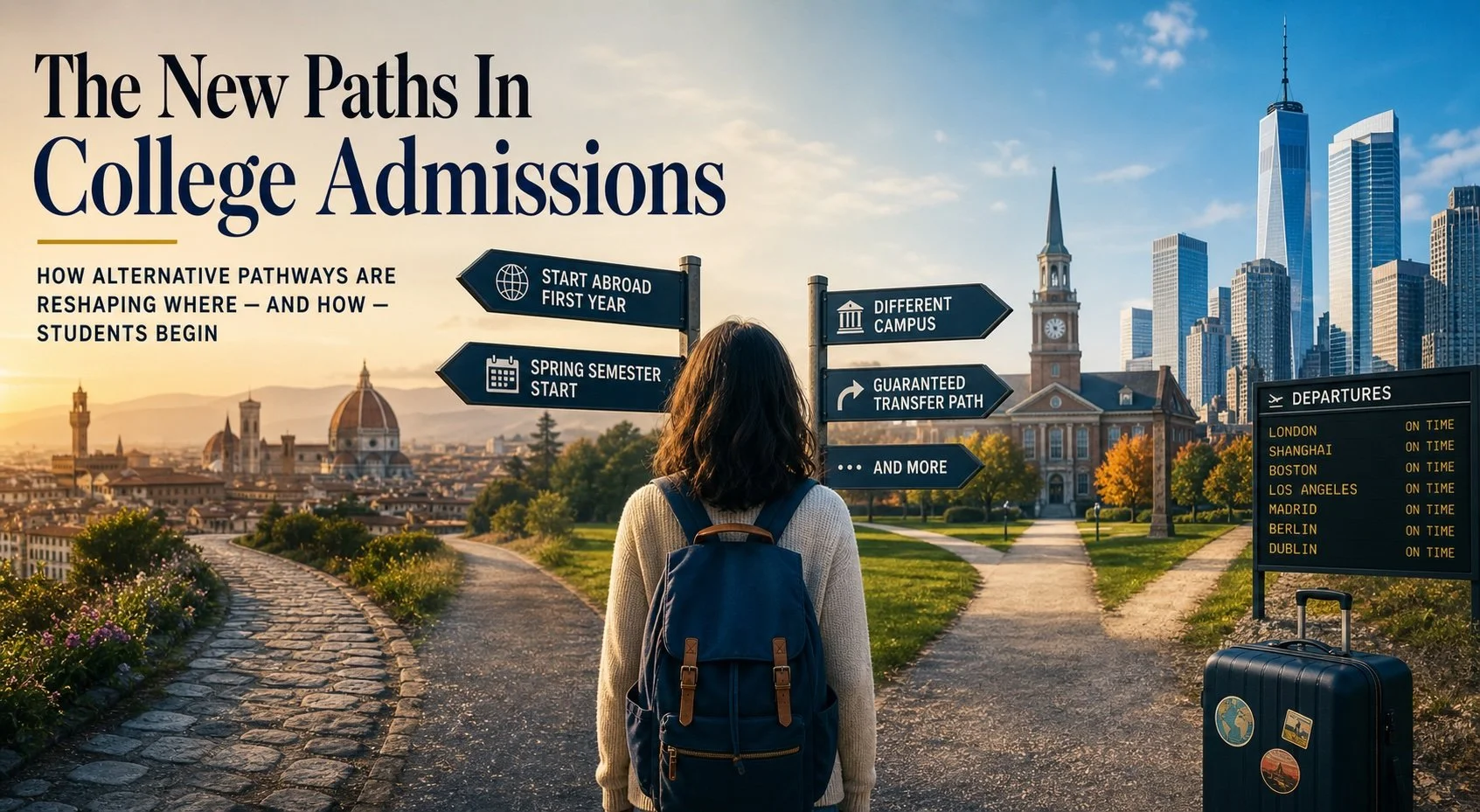
At places like New York University, Northeastern University, and University of Southern California, you now see a growing menu of alternative pathways:
Start your first semester abroad
Begin in January instead of September
Enroll at a partner or satellite campus first
Complete a year elsewhere, then transfer in
Ten years ago, these were edge cases. Now, they’re baked into the system.
And no—that’s not an accident.
What these programs actually do (behind the scenes)
Let me be direct, because this is where families deserve clarity.
These pathways serve three major institutional goals:
1. Managing capacity without expanding it
Dorms are finite. So are lecture halls. Instead of building new infrastructure, colleges can spread students across time and geography.
A fall freshman class might be “full”—but a January class, or a cohort starting in Madrid or London, exists outside that bottleneck.
2. Protecting yield
Yield—the percentage of admitted students who enroll—is one of the most closely watched metrics in admissions.
Students admitted through alternative pathways often:
have fewer competing offers
feel more invested in the opportunity they received
are, statistically, more likely to enroll
From an institutional standpoint, that stability matters.
3. Preserving selectivity optics
Here’s the part that’s rarely said out loud:
By routing some students through alternative programs, colleges can accept more students overall without inflating the size of the traditional fall cohort.
That helps keep headline acceptance rates low, which in turn sustains rankings and perception.
It’s not deception—but it is strategy.
What it means for applicants
From a student’s perspective, these pathways can feel ambiguous.
You got into Cornell University… but you’re starting in January.
You’re admitted to New York University… but your first semester is in another country.
You have a spot at a top school… but only after proving yourself somewhere else first.
So the question becomes: Is this the same as getting in?
The honest answer is: yes—and no.
Yes, because you are part of that institution. You will graduate with that degree.
No, because your path—and your experience—will be meaningfully different, especially at the beginning.
The part colleges get right
It would be unfair to frame these programs purely as institutional tactics. Many of them are genuinely well-designed.
I’ve seen students thrive in ways they might not have on a traditional path:
First-year abroad students often develop independence and adaptability faster
Spring admits sometimes arrive more grounded, having had time to reset or explore
Transfer pathway students tend to be deeply intentional about where they land
For the right student, these can be not just acceptable outcomes—but exceptional ones.
The part no one explains well
Where I think colleges fall short is in how these pathways are communicated.
Because emotionally, they don’t land the same way.
Students compare themselves to peers who are moving in August. They wonder if they were a “backup admit.” They feel, at times, slightly outside the center of things—even when they fully belong.
And practically, there are trade-offs:
Fewer orientation resources or support systems
Social integration that happens off-cycle
Logistical complications (housing, visas, finances)
A sense of starting from a different baseline than the fall cohort
These aren’t dealbreakers—but they are real.
How to think about these offers
If you’re evaluating one of these pathways, here’s the perspective I give students now:
Don’t ask, “Is this as good as a normal acceptance?”
Ask:
Does this path fit how I want to start college?
Am I excited about the experience itself—or just the name attached to it?
What will my first year actually look like, day to day?
Because the truth is, these programs are not consolation prizes.
They are different starting lines.
The bigger picture
What we’re seeing is a fundamental shift in admissions—not just in selectivity, but in structure.
The idea that college begins in one place, at one time, in one uniform way—that’s fading.
In its place is something more complex:
multiple entry points
staggered timelines
globalized beginnings
From the inside, this evolution makes sense. It allows colleges to balance demand, resources, and institutional priorities.
From the outside, it can feel disorienting.
Both perspectives are valid.
A final thought, from someone who’s been in the room
When I used to sit in committee, we weren’t asking, “Is this student good enough?” in the simplistic way people imagine.
We were asking:
Where can this student fit?
When can they start?
How can we make this work—for them and for us?
These alternative pathways are one answer to that question.
They’re not perfect. They’re not purely altruistic. But they are now part of the reality of highly selective admissions.
And if you understand how they work—not just what they look like—you’re already navigating the system more clearly than most.